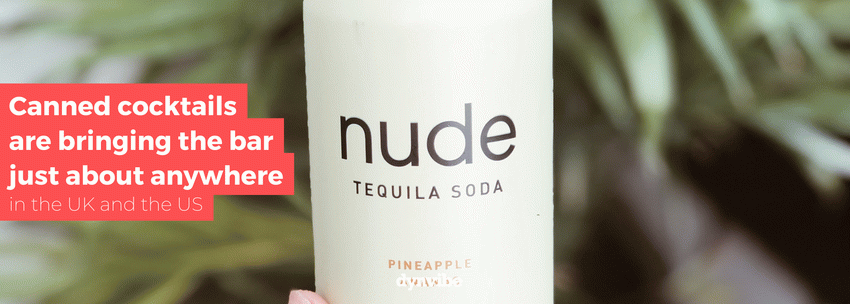
According to Google Trends, there has been a growing consumer interest in canned cocktails in the UK and US over the past 5 years. The topic also raises conversations on the social sphere, with #cannedCocktail getting 774.8K views on TikTok for instance.
People appear to love this fun and simple way to enjoy drinks everywhere.
Marks & Spencer has launched 14 references of canned cocktails. Ranging from classic cocktails such as Gin & tonic and Martini to 0% diet & alcohol-free gin tonic, they are one of the most visible brands on social media surrounding this topic.
They said...
(UK) London’s first canned cocktail bar… CAN you believe it? 😏#thingstodoinlondon #londondateidea #londonactivities #london #londondrinks (TikTok)
(US) Boat Series: Canned drinks I like for boating/beach! It is 69 calories, 0gram of sugar + 2ingredients and 4.9 % alcohol! #winewater #boatdays #cannedcocktail #fyp #hiltonhead #wineme #boatlife #beachdrink (TikTok)
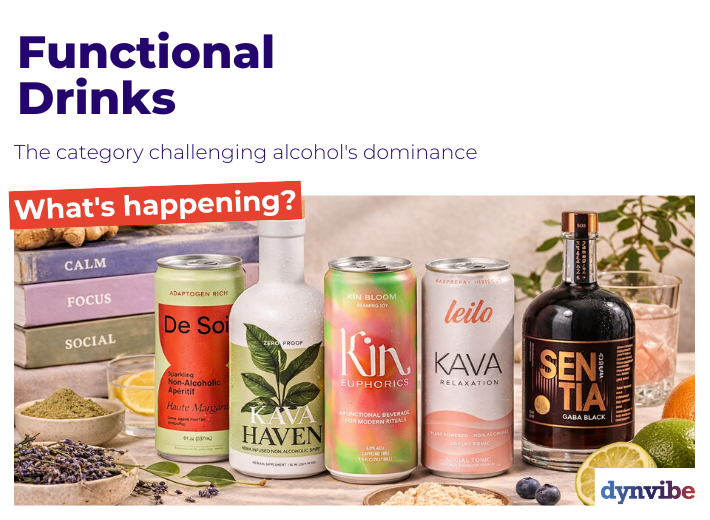
What happens when functional drinks start challenging alcohol’s long-standing dominance?
For decades, alcohol owned social occasions by fulfilling needs for relaxation, connection,
and social ease. Today, these needs are still here, but consumers want to experience them
differently: with more control, well-being, and reassurance.
Driven by strong search growth in the US, functional drinks are emerging as a category of
their own. They promise benefits once associated with alcohol, relaxation, calmness, stress
relief and social confidence but without relying on alcohol.
Adaptogens, kava, L-theanine, GABA, CBD/THC, and botanicals are becoming new proof
points. Ingredients are no longer just part of the formula: they reassure consumers, build
legitimacy, and shape brand positioning.
This shift is attracting a wide range of profiles, from wellness seekers and sober-curious
drinkers to mainstream social drinkers looking for greater balance and control.
At Dynvibe, we dove into online conversations to understand how functional beverages are
reshaping consumption occasions, consumer expectations, and new opportunities for
beverage brands.
If you operate in the beverage space and want to understand the signals already challenging
alcohol’s dominance, you’re in the right place.
05/2026
Beauty
From formula-led to delivery-driven
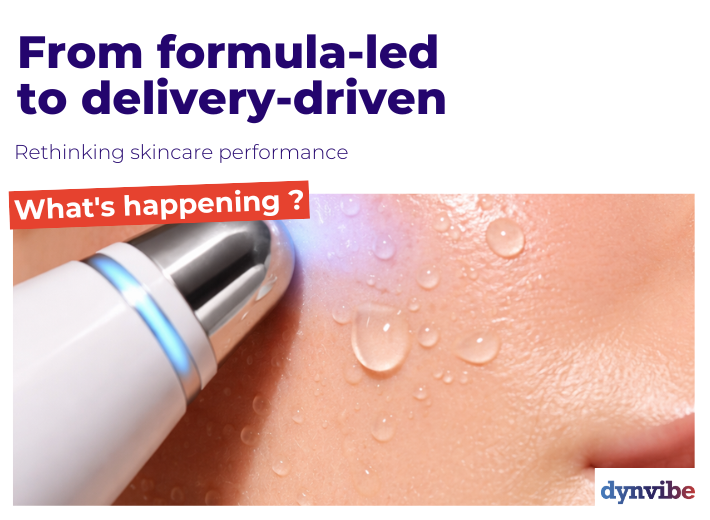
What happens when skincare performance is no longer defined solely by the formula, but by how it actually acts on the skin? A new paradigm is emerging.
Today, consumers are looking beyond ingredient lists. They explore, test, combine and gradually redefine what “efficacy” really means.
Between new techniques, technologies, and increasingly sophisticated routines, skincare is becoming a space of experimentation where every detail matters.
In this context, new signals are gaining importance. From usage to sensorial cues to tools, everything seems to contribute to a different reading of performance.
This shift points to something deeper: a transformation in how consumers perceive, evaluate, and validate results.
At Dynvibe, we’ve dived into online conversations to decode this evolution and uncover the new benchmarks taking shape.
If you’re in the beauty space and looking to spot these emerging signals before they become standards, you’re in the right place.
 AuthorHyunah Lee